
Navi Pillay Height, Age, Husband, Children, Family, Biography
Quick Info→
Age: 85 Years
Hometown: Durban, Natal, South Africa
Husband: Paranjothee "Gaby" Anthony Pillay
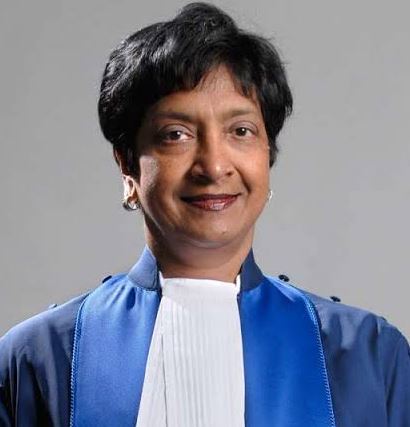
| Bio/Wiki | |
|---|---|
| Full Name | Navanethem Naidoo |
| Profession | Jurist |
| Famous for | Winning Nobel Peace Prize in 2026 |
| Physical Stats | |
| Height (approx.) | 5' 3" (160 cm) |
| Weight (approx.) | 55 Kg (121 lbs) |
| Eye Colour | Black |
| Hair Colour | Black |
| Personal Life | |
| Date of Birth | 23 September 1941 (Tuesday) |
| Age (as of 2026) | 85 Years |
| Birthplace | Durban, Natal, South Africa |
| Zodiac sign | Virgo |
| Nationality | South African |
| Hometown | Durban, Natal, South Africa |
| School | Clairwood High School |
| College/University | • University of Natal • Harvard Law School |
| Educational Qualification | • Bachelor of Arts (BA, 1963) • LLB (1965) • LLM (Harvard, 1982) • Doctor of Juridical Science (Harvard, 1988) |
| Religion | Hinduism |
| Ethnicity | Indian Tamil |
| Relationships & More | |
| Marital Status | Widow |
| Marriage Date | Year, 1965 |
| Family | |
| Husband/Spouse | Paranjothee "Gaby" Anthony Pillay |
| Children | Daughter(s)- 2 • Isvari • Kamini |
| Parents | Father- Narrainsamy Mother- Santhama Naidoo |
| Siblings | 7 Note: She was 5th among 8 siblings. |
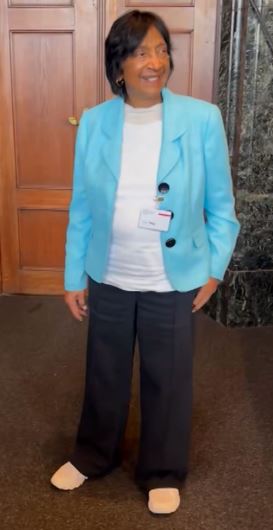
Some Lesser Known Facts About Navi Pillay
- Navi Pillay’s grandparents came from India in the 1890s as indentured servants to work on sugar plantations in Natal, and her grandfather lost both arms in an accident at the sugar mill.
- Her parents, Narrainsamy and Santhama, had an arranged marriage in their early teens and had eight children.
- Narrainsamy worked as a bus driver and took up other jobs such as fishing to add to the family income, while Santhama looked after the home.
- They raised the children with strong Hindu values and stressed equality between the men and women of the family.
- She grew up in Clairwood, a poor and mostly Indian suburb of Durban.
- Most of her classmates in elementary school got married off, but her parents insisted that she and her two other sisters attend school like their brothers.
- Her mother stood in long admission lines and used the birth certificates of her older children to get the younger ones into school.
- With little money for school supplies, Santhama stitched together notebooks for the younger children from blank pages of the used notebooks of the elder ones.
- At school, Pillay found an environment very different from her home, as she learnt a new religion in a new language.
- Teachers could not speak about politics, including apartheid, because they feared action from the school administration.
- She attended Clairwood High School and later became patron of its alumni society.
- Pillay had her first encounter with the law at the age of five, when she testified in court after a robbery.
- Her mother had given her 5 South African Pounds to hand over to her father, which was his wage for the month.
- The court convicted the thief but did not return the money to her father. Her writing drew praise from childhood itself.
- At the age of 10, she wrote an in-class essay on how South African courts gave heavier sentences to black people than to white people, using what she overheard from her parents and teachers, since she had no access to radios or newspapers.
- At 14, she sent an essay to a competition of the Durban Chamber of Commerce on why South Africans should buy South African made goods, and won a bronze medal.
- At 15, she published an essay on the role of women in instilling values in children, and the Jewish Women’s Union gave her an award of books.
- In 1959, South Africa passed the Separate Universities Act, which forced universities that had been desegregated to segregate again.
- Donations from the local Indian community, along with support from the citizens of Clairwood, the Durban City Council and a scholarship from the university, helped Pillay study at the University of Natal.
- The campus was very politically active, and most classes and graduations stayed segregated, which angered many students.
- Under apartheid, Pillay had to share the limited resources given to all non white students. She once shared a required textbook in a non white library with 20 of her classmates.
- After her first year, the new law forced her to move to the nearest non white institution, the University College for Indians at Salisbury Island.
- That college did not offer an LLB programme, while the University of Natal did.
- Pillay sought an exemption from the Minister of Justice, called the office directly when she received no reply, and returned to Natal to finish her degree.
- In 1962, Pillay met her husband, Paranjothee “Gaby” Anthony Pillay, also a lawyer, at a student dance.
- She graduated from the University of Natal with a Bachelor of Arts in 1963. The couple married in January 1965, and Pillay finished her Bachelor of Laws that year.
- They could not conceive, so they adopted two baby girls a few years apart, Isvari and Kamini.
- After university, Pillay could choose between becoming an advocate or an attorney. She chose to become an attorney, which needed two years of articles before admission.
- She did her articles under Narainsamy Thumbi “N.T.” Naicker, a banned member of the African National Congress.
- Naicker often stayed under house arrest, so he relied on Pillay to testify for his clients in court.
- In 1967, Pillay became one of three women admitted as attorneys, and the first non white woman to open her own law practice in the province of Natal.
- She says she had no other option. In her words, “No law firm would employ me because they said they could not have white employees taking instructions from a coloured person”.
- As a non white lawyer under the apartheid regime, she could not enter a judge’s chambers. Pillay spent 28 years as a lawyer in South Africa.
- She defended activists against apartheid from the African National Congress, the Unity Movement, the Black Consciousness Movement and Azapo.
- Saths Cooper and Strini Moodley, leaders of the Black Consciousness Movement, figured among her clients.
- She helped expose the use of torture and the poor conditions of political detainees. Her legal career focused on the preservation of international human rights law, with special attention to rape and sexual violence.
- Her clients advised her to consult judges with expertise in international law and humanitarian law on their cases.
- Police detained her husband in 1971 under the Terrorism Act, and Pillay successfully sued to stop the police from using unlawful methods of interrogation against him.
- In 1973, she won the right for political prisoners on Robben Island, including Nelson Mandela, to have access to lawyers, in State v Kader Hassim and 9 others and State v Harry Gwala and 9 others.
- Her husband’s career broke up during apartheid because of his detention for his activism against it.
- In 1980, Pillay worked as a lecturer at the University of KwaZulu-Natal.
- She applied to Harvard University and attended it in 1981 under the Harvard South Africa Scholarship Program, an exchange programme that anti apartheid activists on the Harvard campus created.
- In 1986, Pillay founded the Advice Desk for Abused Women in Durban along with Anshu Padayachee, and the two first ran it from their own homes.
- Padayachee was a lecturer in criminology and later acted as vice chancellor of the ML Sultan Technikon.
- In 1988, after she completed her thesis, Pillay graduated from Harvard Law School with a Doctorate of Juridical Science.
- She was the first South African to get a doctorate in law from Harvard Law School.
- In 1992, Pillay founded the international women’s rights group Equality Now in New York, along with two other human rights lawyers, Jessica Neuwirth and Feryal Gharahi.
- The group aimed to bring equality for women into the field of human rights.
- As a member of the Women’s National Coalition, she also helped include in the South African Constitution an equality clause that bars discrimination on grounds of race, religion and sexual orientation.
- In 1995, the year after the African National Congress came to power, President Nelson Mandela and the Judicial Service Commission nominated and confirmed Pillay to the High Court of South Africa, under the supervision of the bar association.
- She became the first non white woman to serve on the court. The Judicial Service Commission is a group of jurists hand picked by the President of South Africa, which screens candidates for the High Court and prepares the list of nominees.
- Her work with Mandela against apartheid had made her a familiar name to him, which put her on the short list.
- Soon after her appointment, Mandela called her to congratulate her personally and said, “your appointment gives me great personal joy”.
- Pillay recalls, “the first time I entered a judge’s chambers was when I entered my own.”
- In the same year, she served as vice president of the University of Durban Westville.
- Her time on the High Court stayed short. In 1995, Justice Minister Abdullah Omar and Mandela put forward her name as a nominee to the UN Security Council for a judgeship on the International Criminal Tribunal for Rwanda, and the UN General Assembly elected her soon after.
- She served for eight years, including four years as president, and she was the only woman judge during the first four years of the tribunal.
- Between 1999 and 2003, Pillay served on the tribunal and became President Judge. She moved to Tanzania for the Rwanda tribunal.
- Her marriage lasted around 30 years despite long periods apart. Her husband later suffered from alcoholism and died in the late 1990s.
- On 2 September 1998, in The Prosecutor v Jean-Paul Akayesu, the court indicted Akayesu for individual responsibility for the death and harm of Tutsis during the Rwandan genocide.
- Akayesu was mayor of the Taba commune, where many Tutsi women took refuge, and he instructed a militia group to target and rape civilian women.
- The case set an international legal precedent that rape and sexual assault can constitute acts of genocide and crimes against humanity.
- The court held that crimes against humanity do not depend on discriminatory intent, and that an act counts as one if it forms part of a widespread or systematic attack against any civilian population.
- Pillay said in an interview, “From time immemorial, rape has been regarded as spoils of war. Now it will be considered a war crime.
- We want to send out a strong signal that rape is no longer a trophy of war.” Her tenure on the tribunal is best remembered for this trial.
- Pillay also sat on the trial of Ferdinand Nahimana, Jean Bosco Barayagwiza and Hassan Ngeze, which looked at the role of Radio Television Libre des Mille Collines and Kangura magazine in spreading hate propaganda against Tutsis.
- The tribunal found that Nahimana faced indictment for direct and public incitement to commit genocide during his work at the radio station.
- Barayagwiza faced the same charge for his work at the radio station and for his work with the Coalition for the Defence of the Republic.
- Ngeze faced charges of incitement to genocide for his work with Kangura. Her work at the Rwanda tribunal brought Pillay international recognition and caught the attention of the Women’s Caucus for Gender Justice in the late 1990s.
- Women’s advocates wanted to protect the rights of women while the International Criminal Court took shape.
- The Caucus gained enough momentum to attend PrepCom and the Rome Diplomatic Conference, where it wrote women’s rights into the court’s statute.
- It pushed for a quota for women judges on the bench and for the use of “gender” in place of “sex” in the provisions of the Rome Statute.
- After the court came into being, Pillay became one of its first judges. On 7 February 2003, the Assembly of States Parties to the Rome Statute nominated her to the Appeals Chamber.
- She won election to a term of six years that March. In the same year, she won the Gruber Prize for Women’s Rights.
- She moved to The Hague for the court and served as a member of the Appeals Chamber until 2008.
- One of the first cases before the court was The Prosecutor v Thomas Lubanga Dyilo, on the enlisting of children under 15 years of age in armed militias that fuelled violence between the Hema and Lendu ethnic groups in the Ituri region of north eastern Democratic Republic of the Congo.
- Pillay served on the appeals chamber during the pre trial phase of the case from 2006 until the end of her term in 2008.
- On 24 July 2008, UN Secretary General Ban Ki moon nominated Pillay to succeed Louise Arbour as High Commissioner for Human Rights.
- The United States reportedly resisted her appointment at first because of her views on abortion and other issues, and later dropped its opposition.
- Pillay resigned from the court in July 2008, effective 31 August 2008, to take up her post with the UN.
- At a special meeting on 28 July 2008, the UN General Assembly confirmed the nomination by consensus.
- Her term of four years began on 1 September 2008. Pillay describes the High Commissioner as “the voice of the victim everywhere”.
- In 2009, Pillay called for international action to end caste discrimination and published an opinion piece titled “Tearing down the wall of caste”.
- She later gave an interview to The Nation, where she called for adoption of the UN Principles and Guidelines on caste based discrimination.
- In the same year, she received the Golden Plate Award of the American Academy of Achievement, South Africa, and Forbes ranked her the 64th most powerful woman in the world.
- In 2010, she voiced concern about pressure on private companies to enforce a financial blockade against WikiLeaks, and said such action violated the right of WikiLeaks to freedom of expression.
- In 2011, she supported a gay rights resolution in the UN Human Rights Council, which passed that year.
- During her term, she also signed a document titled “Born Free and Equal”, on sexual orientation and gender identity in international human rights law.
- In a speech on 8 June 2012, Pillay blacklisted the provincial government of Quebec in Canada for human rights violations concerning the rights to peaceful protest and free expression of its student protesters.
- The bill in question, Bill 78, required protest groups of more than 50 people to get approval from authorities at least 8 hours before the planned start of a protest.
- Human rights NGOs reacted in different ways. Quebec official sources criticised Pillay for comparing Quebec with areas known to have worse records.
- Also in 2012, Pillay called for the suspension of sanctions against the government of Robert Mugabe in Zimbabwe.
- Civil society groups in the country criticised the call and accused the Zimbabwean government of manipulating her into overlooking its own human rights violations.
- The court convicted Lubanga that year. Pillay also got a second term of two years as High Commissioner.
- In 2013, Pillay made a strong statement on caste and gender at the UN Human Rights Council.
- She also criticised the Sri Lankan government as an authoritarian state, and alleged human rights violations and atrocities by it against Tamil civilians at the end of the Sri Lankan civil war.
- The government and its supporters put her criticism down to her own Tamil descent. She strongly denies this claim.
- During the 2014 Gaza war, Pillay stated that both Israel and Hamas had likely violated international law.
- She said Israel had engaged in the “apparent targeting of seven children playing on a Gaza beach” during the 2014 Gaza war beach bombings.
- Anne Bayefsky criticised the statement in a Fox News op ed as “incitement to hate”.
- Pillay also criticised US funding of the Iron Dome programme and said, “no such protection has been provided to Gazans against the shelling”.
- Liel Leibovitz described the statement in an article for Tablet as a “hilariously delicious absurdity”.
- On 25 July 2014, the United States Congress published a letter to Pillay signed by over 100 members, who said the Human Rights Council “cannot be taken seriously as a human rights organisation” because of its investigation of Israel’s conduct during the war.
- At a news conference in July 2014, Pillay called Edward Snowden a “human rights defender” and said, “I am raising right here some very important arguments that could be raised on his behalf so that these criminal proceedings are averted.”
- In August 2014, she criticised the international community for its “paralysis” in dealing with the Syrian civil war, which was more than three years old and had caused 191,369 deaths by 30 April 2014.
- Pillay held the post of High Commissioner until 2014. Since 2019, Pillay has served as an ad hoc judge on the Rohingya genocide case, The Gambia v Myanmar, at the International Court of Justice, for crimes of genocide.
- The Gambia brought the case against Myanmar for violating the Genocide Convention in its treatment of the Rohingya ethnic group.
- Myanmar pushed back, but the court admitted the case and continues to hold hearings.
- The case stands out because one signatory of the Genocide Convention, The Gambia, sues another signatory, Myanmar, on behalf of a third party that did not sign, the Organisation of Islamic Cooperation.
- The UN Independent International Commission of Inquiry on the Occupied Palestinian Territory came into being after the 2021 Israel Palestine crisis, and Pillay chaired it.
- The US and Europe voiced strong disapproval of its creation because it had no formal end date.
- Pillay replied, “the occupation does not have an end date either and you tend to support that occupation”.
- In 2023, the World Jurist Association gave her the Ruth Bader Ginsburg Medal of Honor, which H.M. King Felipe VI of Spain presented along with Javier Cremades, President of the association.
- Anshu Padayachee died in July 2023. In June 2024, the commission found that both Hamas and Israel had committed war crimes after the 7 October attacks.
- In July 2025, the three members of the commission announced plans to resign for personal reasons.
- In September 2025, the commission found that Israel had committed genocide during the Gaza war.
- Pillay has denounced Israel for disproportionately targeting civilians, including children, and has said these actions cannot be justified as self defence.
- In an op ed in The New York Times in September 2025, she said the world has an obligation to prevent genocide by stopping military support to Israel and “using all available diplomatic and legal means to stop the killing”.
- She won the Sydney Peace Prize in 2025, and she chaired the commission until November 2025.
- In 2026, Pillay won the Olof Palme Prize. By 2026, the Advice Desk for the Abused, which she co-founded, had helped around 500,000 people.
- The organisation had changed its name from the Advice Desk for Abused Women and widened its support to children, elderly people and people with disabilities, and it had moved to the campus of the former University of Durban Westville.
- As of 2026, Pillay is president of the International Commission Against the Death Penalty, based in Madrid, Spain.
- She also serves as president of the Advisory Council of the International Nuremberg Principles Academy and as chair of the Quasi Judicial Inquiry into Detention in the Democratic People’s Republic of Korea.
- Many universities including Durban University of Technology, City University of New York School of Law, the London School of Economics, Rhodes University, Catholic University of Leuven and Erasmus University Rotterdam have given her honorary degrees.
- In October 2026, Pillay won the Nobel Peace Prize for her efforts to promote peace and international law.
- The Norwegian Nobel Committee said it attaches importance to her role as a driving force in the development of an international system of law and order, and also stressed her judicial rigour, personal integrity and considerable courage.
 Gazal Sood Height, Age, Family, Biography
 Arunabh Kumar Height, Weight, Age, Family, Affairs, Wife, Biography & More
 Farhana Maqsood Height, Weight, Age, Affairs, Husband, Biography & More
 Muhammad Diligent Blesslee Height, Age, Girlfriend, Family, Biography & More
 Tottempudi Gopichand Height, Weight, Age, Wife, Biography & More
 Rahul Tewatia (Cricketer) Height, Age, Wife, Girlfriend, Biography
 Nitin Vakharia Height, Weight, Age, Wife, Family, Biography & More
 Binny Johny (DID Judge) Height, Weight, Age, Girlfriend, Wife, Family, Biography & More