
Nidal Hasan Age, Family, Biography
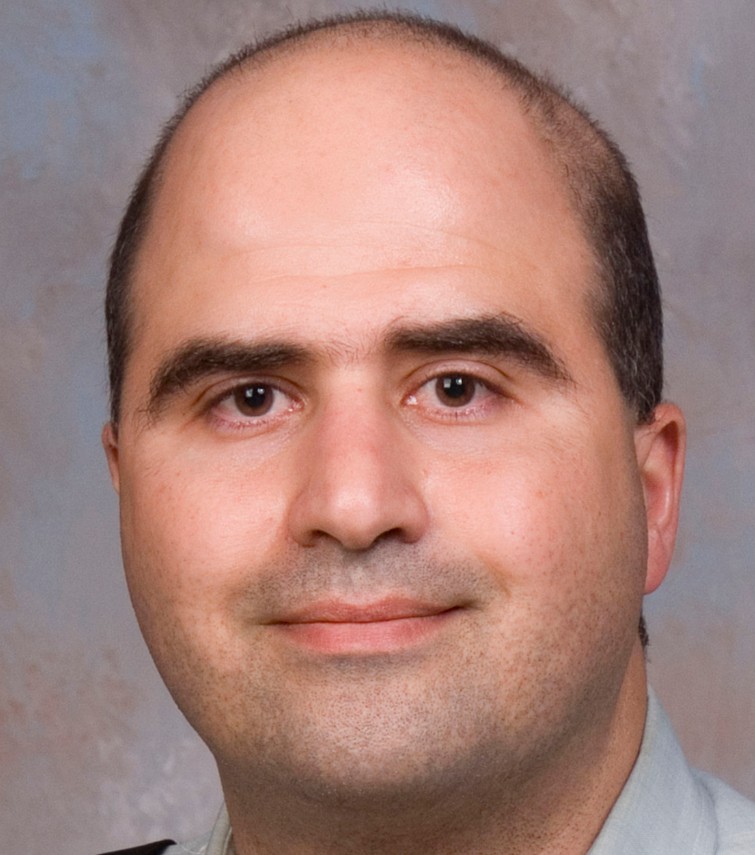
| Bio/Wiki | |
|---|---|
| Full Name | Nidal Malik Hasan |
| Nickname | Michael |
| Profession(s) | Former U.S. Army Major, Medical Corps Psychiatrist |
| Known for | Executing the 2009 Fort Hood shooting in Texas |
| Physical Stats | |
| Eye Colour | Brown |
| Hair Colour | Black |
| Military Career | |
| Allegiance | United States (until 2009) |
| Branch | United States Army Medical Corps (until 2009) |
| Service years | 1988-2009 (dismissal) |
| Rank | Major (revoked) |
| Criminal Information | |
| Motive | • Opposition to military deployment • Islamic extremism |
| Penalty | Death |
| Personal Life | |
| Date of Birth | 8 September 1970 (Tuesday) |
| Age (as of 2026) | 56 Years |
| Birthplace | Arlington County, Virginia, U.S. |
| Zodiac sign | Virgo |
| Nationality | American |
| Hometown | Arlington County, Virginia |
| School | Wakefield High School, Arlington William Fleming High School, Roanoke, Virginia |
| College/University | • Virginia Western Community College, Roanoke • Barstow Community College, California • Virginia Tech, Blacksburg, Virginia • Uniformed Services University of the Health Sciences, Bethesda, Maryland |
| Educational Qualification(s) | • Associate Degree in Science from Virginia Western Community College, Roanoke (1992) • Graduation in Biochemistry with honours from Virginia Tech (1995) • MD and MPH from Uniformed Services University of the Health Sciences |
| Religion | Islam |
| Food Habit | Non-vegetarian |
| Relationships & More | |
| Marital Status | Unmarried |
| Family | |
| Parents | Father- Malik Awadallah Hassan (died in 1998 at age 51) Mother- Hanan Ismail "Nora" Hasan (died in 2001, three years after her husband, at age 49) |
| Siblings | Brother(s)- 2 • Annas Hasan • Eyad Hasan |
Some Lesser Known Facts About Nidal Hasan
- His parents were Palestinian immigrants. They came to the United States from the West Bank.
- Nidal Hasan grew up in a Muslim family. He has two younger brothers.
- Hasan attended Wakefield High School in Arlington for a year.
- When his family moved from Arlington to Roanoke, Virginia, he completed his schooling at William Fleming High School in 1988.
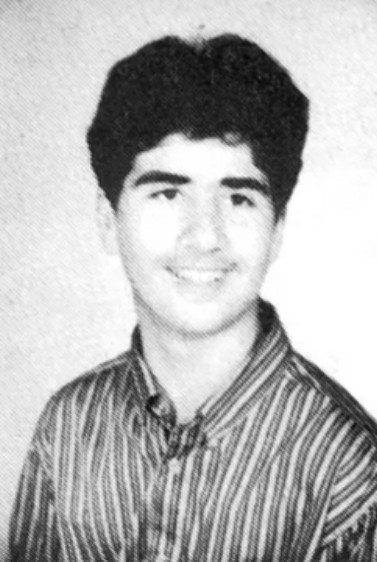
Nidal Hasan’s 1986 high school picture
- His father, who was a businessman, died in 1998. His mother died in 2001.
- After compelting his formal education, he entered the Uniformed Services University of the Health Sciences in Bethesda, Maryland, in 1997. There, he received training of a health professional for military service.
- Hasan received his medical degree in 2003. After that, he then started specialist training in psychiatry at Walter Reed Army Medical Center in Washington, DC.
- He then qualified as a military psychiatrist.
- During his training, Hasan worked many military personnel who were suffering from mental health problems and needed support.
- Later, he also served as a resident and fellow.
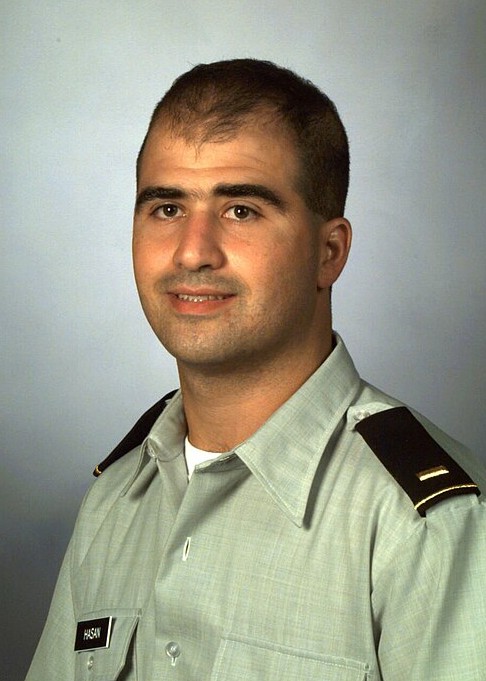
Second lieutenant Nidal Hasan in 2000 as a student at the Uniformed Services University of the Health Sciences
- In 1988, he joined the United States Army. Later, he became a medical officer.
- During his service, he worked at Walter Reed Army Medical Center, where he worked with soldiers who had experienced stress and other difficulties connected with military service.
- His work included treating people who needed psychiatric care. He also studied the effects of trauma on soldiers.
- He also worked at the Center for the Study of Traumatic Stress, which works on studies such as “How traumatic events affect individuals and communities.”
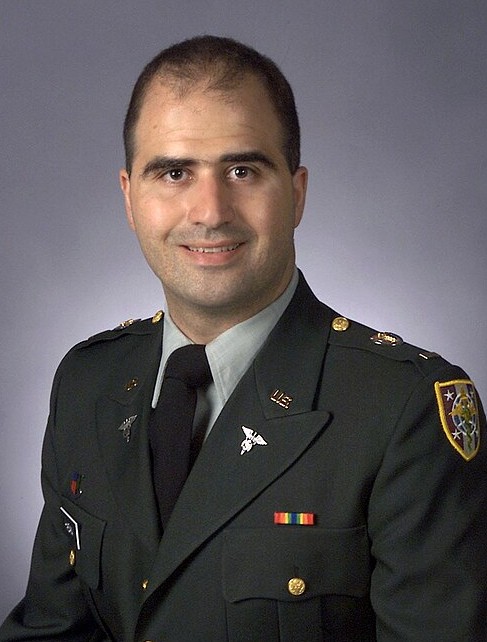
Nidal Hasan in 2003, the year he graduated from the Uniformed Services University of the Health Sciences
- In 2009, Hasan was transferred to Fort Hood in Texas. It was one of the largest US Army bases.
- On 17 May 2009, he was promoted from Captain to Major.
- In July 2009, Nidal Hasan was transferred to Darnall Army Medical Center at Fort Hood, Texas, and moved to Killeen, where he legally bought an FN Five-seveN handgun two weeks later.
- Reportedly, his supervisors and medical teachers gave him a poor performance ratings before his transfer.
- Nidal Hasan was scheduled to be sent to Afghanistan on 28 November 2009.
- Once, he discussed with a local shop owner that he was afraid to go to war because he might have to fight or kill fellow Muslims.
- On the morning of the shooting, he gave away furniture from his home and distributed copies of the Quran, saying that he would be leaving for Afghanistan.
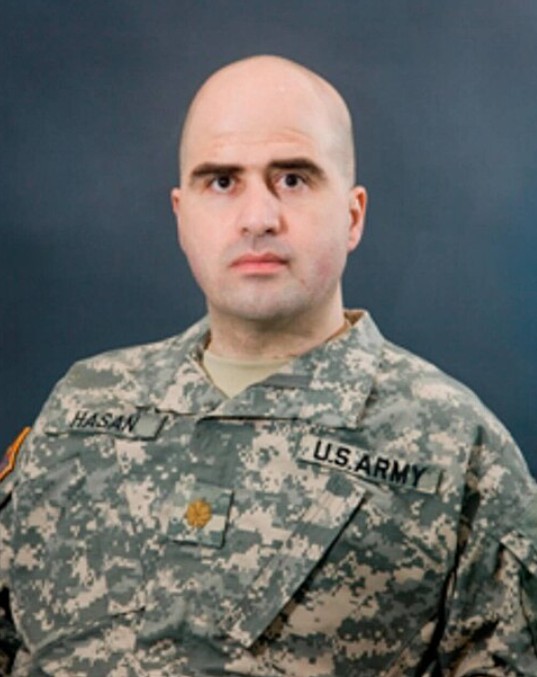
Nidal Hasan in 2009
- On 5 November 2009, he carried out the attack that ended his Army career and changed the lives of many military families.
- On that day, Hasan opened fire inside the Soldier Readiness Processing Center in Fort Hood, Texas. Many soldiers were present at the centre for medical examinations and other preparations before being sent overseas.
- Hasan used handgun to attack people inside the building. He killed 13 people and injured 32 others.
- The victims were only military personnel.
- During the shooting, Hasan shouted “Allahu akbar,” an Arabic phrase meaning “God is great.”
- After that, military police officers shot Hasan and stopped the attack. He survived but was left paralysed from the chest down and later used a wheelchair.
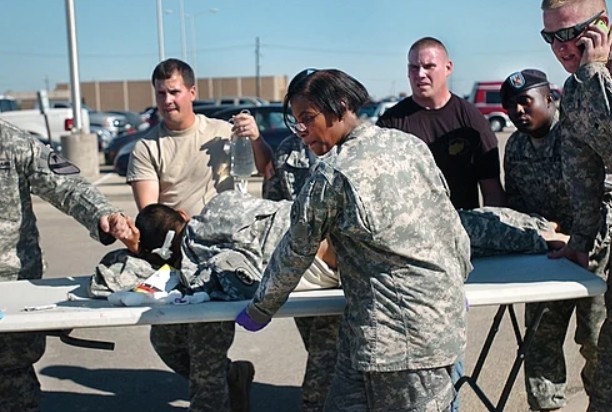
First responders and soldiers transport a fellow soldier wounded in the Fort Hood shooting
- The shooting shocked the United States and raised questions about safety at military bases. It also led to concerns about how the Army and intelligence agencies had handled information about Hasan before the attack.
- After the shooting, the Army Criminal Investigation Division started a criminal investigation with the help of FBI and other agencies.
- Before the attack, some of Hasan’s colleagues had raised concerns about his behaviour and comments. One of his colleague stated,
The fatal shooting of two recruiters in Little Rock, Arkansas, greatly affected Hasan. Hasan made “outlandish” statements against the American military presence in Iraq and Afghanistan, reportedly saying that “the Muslims should stand up and fight against the aggressor,” referring to American soldiers.”
- His conduct and communications later became important parts of official investigations.
- During investigations, the authorities examined his communications through exchanged emails with Anwar al-Awlaki and other information about his beliefs and plans. Anwar al-Awlaki is a radical cleric, who later joined al-Qaeda in Yemen.
- His 2007 presentation to other medical professionals about Muslim soldiers who might not want to fight with other Muslims received attention during investigations because of its subject and Hasan’s views about military service. The title of his presentation was “The Quranic World View as It Relates to Muslims in the U.S. Military.”
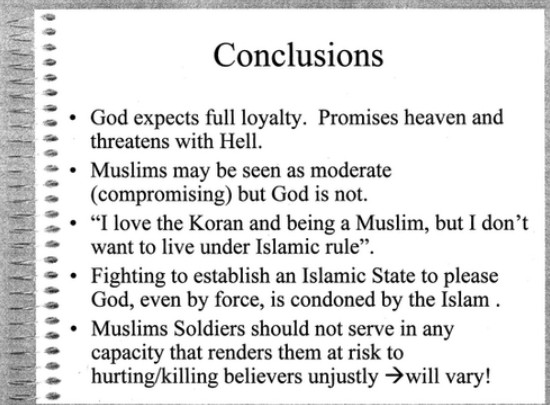
Slide 49 of 50 of The Quranic World View As It Relates to Muslims in the U.S. Military, a presentation made by Hasan during a symposium of U.S. Army physicians at WRAMC
- Earlier, the FBI investigated some of these communications in 2008, but concluded at the time that they could be connected to Hasan’s professional research. The information did not lead to action that stopped the later attack.
- After the shooting, the FBI and other agencies reviewed how the information had been handled.
- The William H. Webster Commission found problems with FBI policies, technology, information review procedures, and training.
- The commission also recommended changes to improve how information was assessed and shared.
- The government findings stated that some early warning signs had not been properly investigated.
- They recommended improvements in communication, training, and the sharing of information between agencies.
- The case also led questions such as how military authorities should respond when a service member makes troubling comments or communicates with people who are suspected of supporting violent extremism.
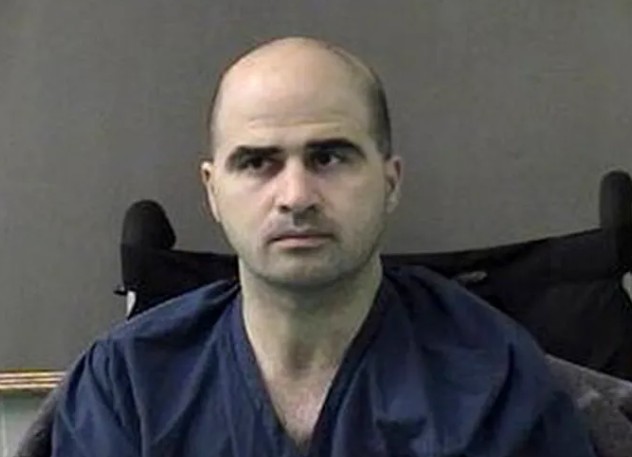
Nidal Hasan during investigations
- During investigations, Nidal Hasan’s cousin, Nader Hasan, said that Hasan feared going to war.
- He heard the experiences of soldiers suffering from post-traumatic stress disorder (PTSD).
- Nader also said that Hasan was harrased by his fellow soldiers. he had also hired a military lawyer who helped him in leaving the Army.
- Hasan’s aunt said that Hasan wanted to leave the military because he was harrased due to his Muslim faith.
- His uncle, Rafiq Hamad, described him as a quiet and gentle person who was once deeply affected by the death of his pet bird.
- His cousin, Mohammed Hasan, said that Hasan did not want to go to Afghanistan or Iraq because he feared violence and death. He added that Hasan felt that people treated him differently because he was Muslim and Arab.
- Military records showed that Hasan was unmarried. However, a former neighbour claimed during investigations that he had lived with two sons in 1997.
- Hasan faced a military trial, known as a court-martial, at Fort Hood in 2013.
- He appeared during all the court proceedings.
- The trial lasted 22 days. It included the testimonies of survivors and relatives of those who had died.
- During the proceedings, Hasan admitted that he was responsible for the shooting.
- He said that he had decided to “switch sides” in what he viewed as a war between the United States and Muslims.
- On 23 August 2013, the military jury found him guilty of 13 counts of premeditated murder and 32 counts of attempted premeditated murder.
- Five days later, on 28 August 2013, the jury sentenced him to death.
- After that, he was dismissed from the Army.
- He was also ordered to give up his military pay and allowances.
- His conviction and sentence then went through the military appeals process.
- In March 2024, the United States Court of Appeals for the Armed Forces supported Hasan’s conviction and death sentence.
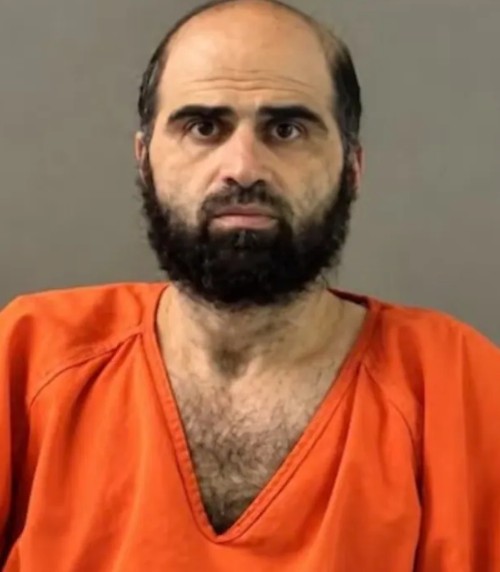
Nidal Hasan during court trials
- On 31 March 2025, the US Supreme Court refused to review his case. This was a major step in the completion of his appeals.
- On 2 October 2026, Donald Trump, President of United States of America, approved the death sentence.
- On 6 October 2026, Acting Secretary of the Army Adam Telle directed that Hasan be executed by firing squad at Fort Hood, Texas, at 1 p.m. Central Time on 3 December 2026.
- The Army announced the scheduled date on 7 October 2026.
- Hasan was being held at the United States Disciplinary Barracks at Fort Leavenworth, Kansas.
- In October 2026, the Pentagon, the headquarters of the United States Department of Defense, announced the plans to livestream the execution.
- The decision attracted public debate about whether an execution should be broadcast. Hasan’s lawyer raised concerns about the plans and said further legal action could still be possible.
 Mahesh Joshi Age, Caste, Wife, Children, Family, Biography & More
 Top 10 Highest Paid IPL 2018 Players
 Uday Ruddarraju Biography
 Shagun Daggar Height, Age, Boyfriend, Family, Biography & More
 Netra Mantena Height, Age, Boyfriend, Husband, Family, Biography
 Sourabh Yadav Height, Family, Biography
 Nivedhithaa Sathish Height, Age, Boyfriend, Husband, Family, Biography & More
 Pippa Middleton Height, Weight, Age, Biography, Husband & More