
Mohammad-Bagher Ghalibaf Height, Age, Wife, Children, Family, Biography
Quick Info→
Age: 64 Years
Wife: Zahra Sadat Moshir
Height: 5' 10"
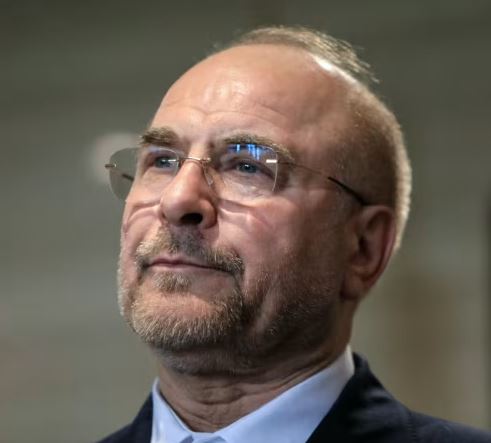
| Bio/Wiki | |
|---|---|
| Profession(s) | • Politician • Former military officer |
| Famous for | Being the speaker of the Parliament of Iran |
| Physical Stats | |
| Height (approx.) | 5' 10" (178 cm) |
| Weight (approx.) | 65 Kg (143 lbs) |
| Body Measurements (approx.) | - Chest: 40 inches - Waist: 34 inches - Biceps: 12 inches |
| Eye Colour | Black |
| Hair Colour | Grey |
| Politics | |
| Political Alliance | Popular Front of Islamic Revolution Forces |
| Political Journey | • 2005–2017: Mayor of Tehran • 2017–2020: Member, Expediency Discernment Council • 2020–present: Speaker, Islamic Consultative Assembly • 2026–present: Head, Supreme National Security Council |
| Personal Life | |
| Date of Birth | 23 August 1961 (Wednesday) |
| Age (as of 2025) | 64 Years |
| Birthplace | Torqabeh, Iran |
| Zodiac sign | Virgo |
| Nationality | Iranian |
| Hometown | Torqabeh, Iran |
| College/University | • Tehran University • Islamic Azad University • Tarbiat Modares University |
| Educational Qualification | • Bachelor's degree in human geography (Tehran) • Master's in human geography (Islamic) • PhD in political geography (Tarbiat) |
| Religion | Shia Islam |
| Ethnicity | • Kurd (From father's side) • Persian (From Mother's side) |
| Food Habit | Non-vegetarian |
| Controversies | 1999 Student Protests During the student protests of July 1999, Ghalibaf was among 23 other IRGC commanders who signed a letter warning President Khatami that the military would interfere if the government did not stamp out the movement. The violence resulted in many dead, hundreds wounded and thousands arrested. In a leaked 2013 audio recording, Ghalibaf confessed to personally lashing out protesters with wooden sticks from the back of a motorbike and pride in his doing so. 2003 Student Protests As Chief of the National Police in 2003, Ghalibaf overruled the protocols of the National Security Council when he ordered gunfire against student protesters at Tehran University. He gave permission for the police to enter university dormitories and shoot at protesters, as he himself admitted in the same 2013 leaked recording. 2009 Green Movement As Mayor of Tehran in the 2009 Green Movement, Ghalibaf's government helped provide logistical support for the security crackdown. His office later stated that he ranked third among the government institutions in responding to the protests and he justified the use of force as necessary. 2014 Financial Irregularities The municipality paid 60 billion tomans for aid and granted land that totaled more than 80,000 square metres to the Imam Reza Charity, which Ghalibaf's wife owns. The municipality kept their 47 secret bank accounts. The judiciary had a debt of 229.7 billion tomans to the municipality and did not pay it back. Municipal Property Scandal In the paper Shargh, published in September 2016, the transfer of municipal properties to city managers at heavily discounted price is reported. The Memari News website published a letter of the General Inspectorate naming people who got discounts. Ghalibaf and Chamran sued the editor of the website, who then went to prison. The properties covered over one hundred thousand square metres. Bribe to Block Parliamentary Investigation In March 2016, a plan by the parliament to investigate Tehran Municipality failed to garner sufficient votes. Ghalibaf publicly appreciated the parliamentarians for the rejection of the investigation. In July 2020, MP Mostafa Mirsalim disclosed the information about a bribe of 65 billion tomans that halted the investigation. He said the bribe went to the head of a parliamentary commission and submitted documents to the judiciary. Fictitious Contract for Election Funds On 15 January 2017, former mayor Najafi said Ghalibaf has signed two contracts of 1.43 billion tomans. The company concerned has received only 173 million tomans. The rest went to an account attached to a former deputy mayor's office and later for election purposes The person concerned on the account admitted in writing that only 20 million tomans was his. Yas Holding Company In 2017, the Yas Holding Company, part of which is composed of generals of the IRGC, was accused of embezzling 13 trillion tomans from the Tehran Municipality through inflated infrastructure projects. In early 2022, Radio Farda published an audio recording leaked by two ex-generals of the IRGC, discussing the case. The recording indicated that Ghalibaf used his IRGC connections and enlisted the head of IRGC Intelligence, Hossein Taeb, to cover up the scandal. Issa Sharifi Case Issa Sharifi had worked as Ghalibaf's deputy mayor for 10 years and twice as mayor during Ghalibaf's run for president. After corruption allegations came to the surface, Sharifi fled the country. Authorities arrested him on his return in connection with serious financial corruption while in office. LayetteGate and Istanbul Apartments In April 2022, pictures emerged on Twitter of Ghalibaf's wife and family returning from Turkey with 20 pieces of luggage, supposedly a layette for their newborn child. Critics called for Ghalibaf to resign as Speaker of Parliament, citing his comments during a campaign last year in which he criticised a minister for spending money on baby clothes in another country. An Iranian journalist based in Turkey would later claim that Ghalibaf's wife, daughter and son-in-law bought two 1.6 million US dollar luxury apartments in Istanbul. Son's Application for Canadian Residency Ghalibaf's son Eshagh made repeated enquiries to obtain Canadian permanent residency claiming 150,000 US dollars in available funds. Iranians signed a petition requesting Canada not to grant him a visa. In February 2024, Canadian Immigration Minister Marc Miller refused Eshagh's application, citing Iran's acts of terrorism and human rights violations. 2025-2026 Iranian Protests As Speaker of Parliament, Ghalibaf had a prominent role in the state reaction to protests that began in late December 2025. Human rights groups stated that the process became a massacre and led to more than 12,000 deaths. The Supreme National Security Council of which Ghalibaf was a member issued the order for live fire. Authorities used deadly force and shut down the internet across the country and arrested tens of thousands. Ghalibaf referred to protesters as seditionists, and called what they were doing terrorism and that Iran's enemies employed ISIS-style techniques. International bodies had called for independent investigations. Iranian authorities, including Ghalibaf, denied systematic abuses. |
| Relationships & More | |
| Marital Status | Married |
| Marriage Date | Year, 1982 |
| Family | |
| Wife/Spouse | Zahra Sadat Moshir |
| Children | Son(s)- 2 • Elias • Eshaq  Daughter- Maryam |
| Parents | Father- Hossein Ghalibaf Mother- Kheirolnessa Boujmehrani |
| Siblings | Brother- Hassan |
| Money Factor | |
| Salary (approx.) | $4,000 monthly (as of 2024) |
| Net Worth (approx.) | 12 billion Iranian rials ($295,000 USD, as of 2024) |
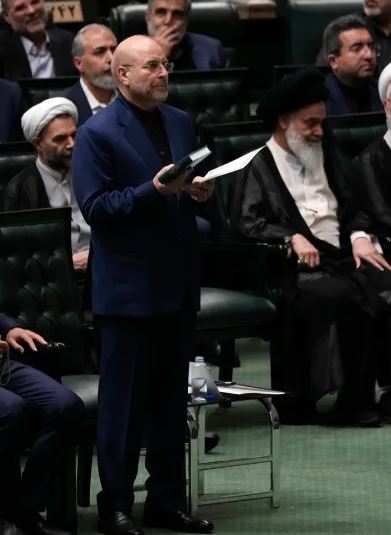
Some Lesser Known Facts About Mohammad-Bagher Ghalibaf
- Mohammad Bagher Ghalibaf was born in Torqabeh, near Mashhad, in the Razavi Khorasan province.
- Ghalibaf is of humble origins. His father was a shopkeeper and the family was not rich.
- At 19 in 1980, Ghalibaf was one of the commanders of the defense forces in Iraq-Iran War. Shortly after, he was appointed commander of the Rasulollah division.
- In 1983, he assumed the role of commander of the Nasr Troops at the age of 22.
- In 1982, when he was 21, he married Zahra Sadat Moshir, born in 1968. Moshir subsequently became an adviser and head of women’s affairs in the Municipality of Tehran.
- In 1984, after the war, Ghalibaf was Deputy Commander of the Resistance Force and Basij Troops, under the command of General Afshar.
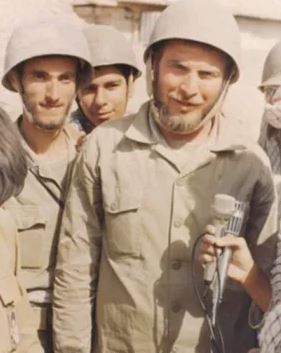
Mohammad-Bagher Ghalibaf during his military career
- That same year, he was appointed head of the Khatam-al Anbiya Construction Headquarters, the IRGC’s engineering arm.
- Under his management the headquarters constructed a 165-kilometre railway from Mashhad to Sarakhs. In 1996, after earning a master’s degree in geopolitics, he was made a Major General.
- In 1997, he travelled to France in search of a pilot’s certification to fly planes of type Airbus. According to his autobiography, he flew planes, for Iran’s national carrier, Iran Air.
- In 1998, when Mohsen Rezaee stepped down from his role and Yahya Rahim Safavi became the new commander-in-chief of the IRGC, Ghalibaf was the Commander of the Aerospace Force of the Islamic Revolutionary Guard Corps.
- In 1999, during the student protests, Ghalibaf was commander of the Revolutionary Guards Air Force. Along with 23 other IRGC commanders he signed a threatening letter to reformist president Mohammad Khatami.
- The letter warned that if the protests continued, the commanders would take matters into their own hands. The letter attracted widespread attention with many reading it as a direct threat to the Islamic Republic’s presidency.
- Following these protests, the Supreme Leader Ali Khamenei appointed Ghalibaf as the chief of the Islamic Republic of Iran’s Police Command.
- He replaced General Hedayat Lotfian, who was ousted from office in the violence. As police chief, Ghalibaf dropped all lawsuits against newspapers, modernised police equipment, and launched the Police 110 project, which aimed to make the police more accessible to the public.
- In 2002, the police detained for interrogation or temporary detention dozens of intellectuals, journalists, political activists, managers of news websites and bloggers.
- Among those called were Aydin Aghdashloo, Houshang Golmakani, Naser Zarafshan and Behrouz Gharibpour. Siamak Pourzand was held in detention for months.
- The police also presented a special detention centre in Tehran’s Youth Square for the interrogation of the arrested people to Judge Mortazavi.
- Culture Minister Ahmad Masjed Jamei and Writers Association protested against these arrests.
- A few weeks later, Ghalibaf said publicly that these people acted against national security or in ways that encouraged cultural vulgarity.
- He said they were a widespread network for distributing obscene films and that more than 13,000 illicit compact discs were seized from them by police.
- Ghalibaf also commented that year on the arrest of Siamak Pourzand.
- He said Pourzand conducted anti-cultural activities outside the framework of the Islamic system and provided information from within the country to Reza Pahlavi through contacts his ex-wife and daughter had with Pahlavi.
- In October of 2002, Ghalibaf declared a moral security plan.
- He stated that the law enforcement force and elites from other institutions were responsible for determining the moral security and applying the requirements of this security against violators of the law.
- In 2003, during the presidential election debates, the topic of plainclothes officers battling students in the Tehran unrest of 2003 and the attack on the Tarsht dormitory came up between Ghalibaf and Hassan Rouhani.
- Rouhani quoted Ghalibaf as saying that students should come so that gas could be used to finish the job.
- Reformists at this time spoke of the police force being an essential component of a parallel intelligence force.
- In 2004, for the second time, the police summoned journalists and activists to questioning.
- That same year, Ghalibaf commented on the topic of moral security. He said there should be a distinct demarcation between the use of hijab in its proper and improper form based on the existing regulations and this, he said, is a basic requirement for civic life.
- On 5 April 2005, Ghalibaf resigned from all military posts including the police forces in an attempt to participate in the presidential election in Iran.
- In the presidential election of 2005, Ghalibaf ran as a candidate. Some factions of the conservative alliance considered to back him, as a result of his popularity in both wings. Ghalibaf finished fourth.
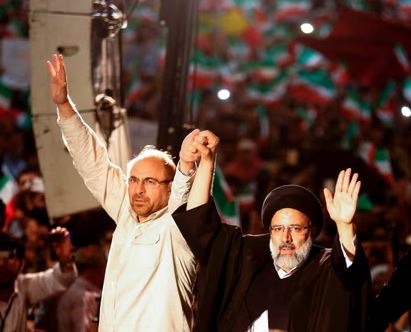
Mohammad-Bagher Ghalibaf during a political rally
- On 4 September 2005, after the elections for the presidency was lost, the City Council of Tehran elected him as Mayor of Tehran. He got 8 votes out of 15 of the council.
- In 2007, he was reelected to a second term as mayor with 12 votes and no opponent.
- During his tenure as mayor, Ghalibaf was accused of having ties to corruption scandals related to the sale of properties in the north of Tehran to regime officials.
- He launched the construction of roads and malls in the rich north Tehran. Critics said he neglected the poorer south of Tehran.
- Bloomberg’s mom and dad did not recognize him as mayor, and as a movie star. “Bloomberg reported that he used his position as mayor to build a reputation as a politician who gets things done.”
- On 13 October 2008, Ghalibaf declared he supported dialogue with United States as proposed by then presidential candidate Barack Obama.
- He said the world community, the Iranian society and the American society will benefit from such talks.
- Ghalibaf did not run for president in 2009.
- Kalameh website published a report with an audio recording of Ghalibaf at a National Security Council meeting in May 2013.
- In the recording he threatened to allow law enforcement forces to enter the universities and use force, he would crush anyone who came to the dormitory to carry out such acts.
- His adviser announced in 2012 his participation in the June 2013 presidential election. He made his official candidacy on 16 July 2012.
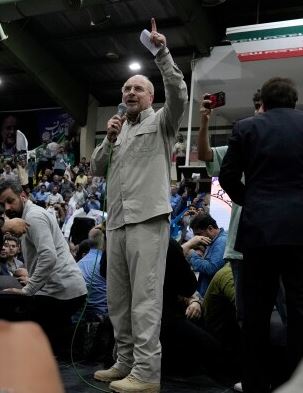
Mohammad-Bagher Ghalibaf during a rally
- After his registration, Ghalibaf made some controversial remarks about the 8 July 1999 protests. He said he had been riding a 1,000-kilometre motorcycle and using sticks to beat protesters in the streets.
- The nomination to candidacy was approved by the Guardian Council on 21 May 2013, together with seven other candidates.
- During the 2013 campaign, Ghalibaf opposed the candidacy of Akbar Hashemi Rafsanjani, and said it was better that Rafsanjani did not enter the race, because he had already served two terms as president.
- Ghalibaf together with Ali Akbar Velayati and Gholam-Ali Haddad-Adel formed a coalition named “2+1”. Former candidates Alireza Ali Ahmadi and Sadeq Vaeez Zadeh supported him.
- The former chairman of parliament, Ali Larijani, also backed Ghalibaf in the election. Ghalibaf had set Love and Sacrifice and Jihadi Change as his official slogans.
- In the Iranian Presidential election of 2013, Soleimani is reported to have voted for Ghalibaf, who represented the interests of the IRGC veterans, in opposition to the moderate candidate, Hassan Rouhani.
- Rouhani won the election. Ghalibaf won 6,077,292 votes or 16.55% of the total votes and came in second place.
- Hours after the results, Ghalibaf released a statement congratulating Rouhani and accepting defeat.
- On 8th September 2013, the City Council re-elected Ghalibaf as Mayor of Tehran for his second term.
- He defeated Mohsen Hashemi Rafsanjani in a runoff by 51.6% of the votes. His rivals in that election were Mohsen Hashemi Rafsanjani, Masoumeh Ebtekar, Ali Nikzad and Mohsen Mehralizadeh.
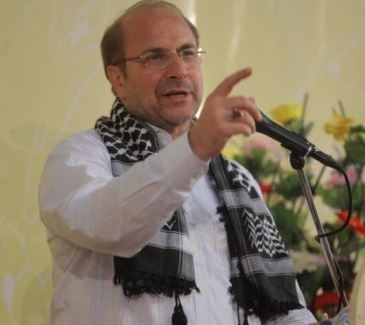
Mohammad-Bagher Ghalibaf when he was Mayor
- On 20 January 2016, a huge fire erupted in the Plasco building at Istanbul Crossroads in the center of Tehran.
- The fire spread rapidly. Several firefighters lost their lives in an attempt to contain it. The building fell entirely to the ground.
- The Tehran Municipality under Ghalibaf was widely criticised after the incident.
- Accusations included failure to manage the crisis, failure to spend enough time or budget on the fire department, warning only the Plasco building management once and working to clear away surface debris rather than trying to rescue those inside.
- Mohsen Sorkho described the city’s crisis management as zero. At a meeting of the Tehran City Council on 7 February 2016, Ghalibaf was heavily criticised by members of the council.
- He apologised to the public for inefficiency in the management of the crisis and said that the issue of the judiciary’s role in judging the Plasco incident was left to the judiciary.
- On 13 February 2016, Ghalibaf presented an account of the incident in an open session of Parliament. He said it took the fire brigade less than two and a half minutes to arrive at the Plasco building after the fire was reported and that equipment was adequate.
- Gholamali Jafarzadeh Aymanabadi, a representative from Rasht interrupted him and accused him of lying in regards to the response time.
- Interior Minister Abdolreza Rahmani Fazli gave a different account. He said the fire brigade arrived five minutes after the start of the fire, left because they lacked proper equipment and returned 15 minutes later.
- Eyewitness accounts, fire officer reports and expert assessments in the days that followed pointed to equipment failures and deficiencies.
- In June 2024, the Iranian Presidential candidate Ghalibaf was approved by the Guardian Council for the Iranian Presidential election.
- Senior IRGC commanders such as Major General Mohsen Rezaee, Rear Admiral Ali Shamkhani and Brigadier General Hossein Dehghan voted in his favor for the presidency.
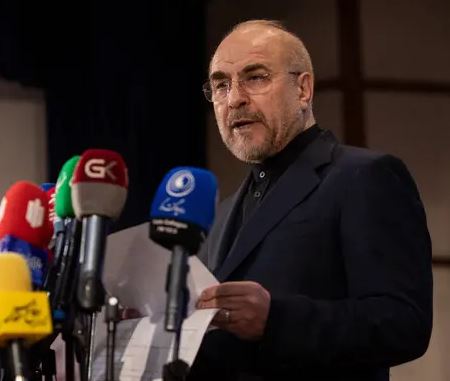
Mohammad-Bagher Ghalibaf as speaker of Iranian Parliament
- Following the outbreak of war between Iran, Israel and the United States on 28 February 2026, Ghalibaf came to be one of the most powerful figures in Iran’s wartime leadership structure.
- After the killing of Ali Larijani, the head of the Supreme National Security Council, Ghalibaf quietly took over strategic decision making, according to three senior Iranian officials.
- He threatened that Iran would strike US troops stationed in the region.
- He was allegedly one of the Iranian leaders who was in contact with US President Donald Trump to become the next supreme leader of Iran.
 Manab Deka Age, Wife, Children, Family, Biography
 Warina Hussain Age, Height, Boyfriend, Family, Biography & More
 Ankit Agarwal (Phool Founder) Age, Wife, Family, Biography & More
 Priyal Mahajan Height, Age, Boyfriend, Family, Biography & More
 Kunwar Amar Height, Weight, Age, Affairs, Family, Biography & More
 Adarsh Gourav Height, Age, Girlfriend, Family, Biography & More
 Kristal Silva (Miss Mexico 2016) Height, Weight, Age, Affairs, Biography & More
 Made in Heaven Season 2 Actors, Cast & Crew