
Vibhav Altekar Height, Age, Family, Biography
Quick Info→
Age: 30 Years
Height: 5' 10"
Hometown: California

| Bio/Wiki | |
|---|---|
| Full Name | Vibhav Satsheel Altekar |
| Profession | Perception Engineer |
| Famous for | Designing the drone ship that saved US soldiers in Hormuz |
| Physical Stats | |
| Height (approx.) | 5' 10" (178 cm) |
| Weight (approx.) | 65 Kg (143 lbs) |
| Body Measurements (approx.) | - Chest: 40 Inches - Waist: 32 Inches - Biceps: 11 Inches |
| Eye Colour | Black |
| Hair Colour | Black |
| Personal Life | |
| Date of Birth | 13 December 1995 (Wednesday) |
| Age (as of 2025) | 30 Years |
| Birthplace | Pune, Maharashtra, India |
| Zodiac sign | Sagittarius |
| Nationality | American |
| Hometown | California, USA |
| School | Lynbrook High School |
| College/University | University of California, Davis |
| Educational Qualification | Graduate in Electrical Engineering |
| Social Media | • Facebook |
| Family | |
| Parents | Father- Satsheel Altekar |
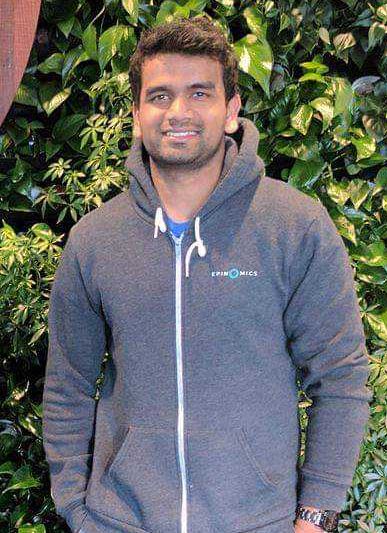
Some Lesser Known Facts About Vibhav Altekar
- Vibhav Altekar was born in Pune, India native.
- He later moved to the San Francisco Bay Area (SFBA) of California, where his father Satsheel Altekar, was active in the North West Region (NW) of the United States of America (USA) Cricket Association’s development of youth cricket.
- Altekar had a passion for cricket from an early age and played for the North West Region in competitive cricket.
- He bowled right arm medium pace and batted at right hand.
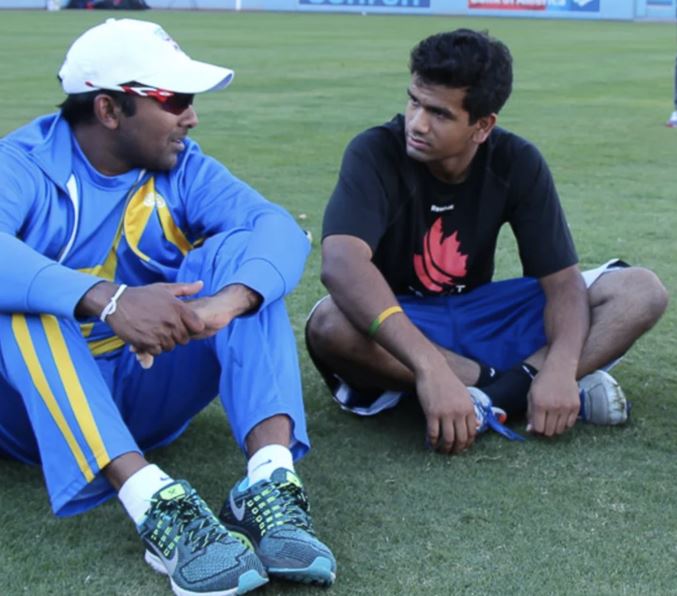
Vibhav Altekar with Sri Lankan cricketer Mahela Jayawardene during his cricket playing days
- He played for the North West Region in August 2014 against the Central East Region in a Twenty20 match at Lauderfield, Florida.
- Altekar had a penchant for science and engineering from an early age, even as he was playing cricket.
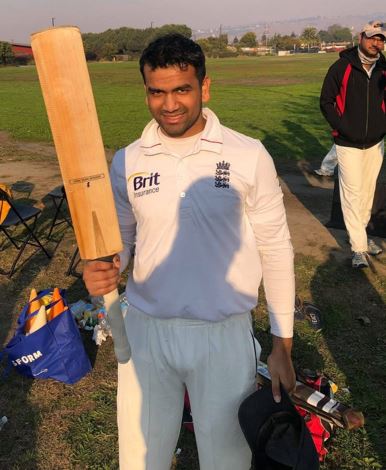
Vibhav Altekar during his teenage years
- In June 2013, and during his school years, he began his research at the University of California, San Francisco, on a micro-fabricated oral drug delivery device that involved the application of photolithography and etching to deliver the drug in a controlled manner.
- In 2014, the project won him the Grand Prize at the Synopsys Silicon Valley Science and Technology Championship, third place at the California State Science Fair and fourth place in engineering at the Intel International Science and Engineering Fair.
- He joined Electrical Engineering School at the University of California in Davis.
- He has also had the opportunity to work in the UC Davis Department of Chemical Engineering and Materials Science from 2014 to 2015, analysing high voltage explosions of oil-water miscibility interfaces in MATLAB and R to validate Maxwell’s Charge Transfer Theories.
- He, also at the same time, started an internship at Vexata in California, developing and testing a system that measured real-time derating using a Raspberry Pi microcontroller unit for a supercapacitor discharge module.
- Altekar served as a machine learning researcher at UC Davis in the bioinformatics field from 2015 to 2017 and was involved in research with graph-based recurrent neural networks applied to transcriptomics and gene regulation at the Genetics and Biomedical Sciences Facility.
- He took a break from his studies to work as an engineering intern in the San Francisco Bay Area at Twitter in January 2017.
- He contributed to the development of machine learning algorithms for real-time celebrity detection and tools to help with the monitoring of server provisioning.
- The following year, he joined Juicero as an embedded systems intern as part of the Kleiner Perkins Engineering Fellowship.
- He also joined Synthego Corporation in August of 2017 where he served as a data engineering intern and created cell data and imagery serverless ETL pipelines.
- He also worked as embedded DSP engineer at Intel Corporation in Santa Clara, in 2016, while still in his undergraduate program, on classification algorithms for EEG data on wearable, head-worn glasses.
- The project was sent at the Fashion Week of Paris in the year 2016.
- Vibhav Altekar was an Engineering Fellow at Kleiner Perkins in 2017 until mid-2018.
- At the same time, he became part of the investment team at 8VC in 2018, as the only engineer developing the minimum viable product of Standard Metrics, an investment management platform that grew out of 8VC.
- During this period, he also helped in technical due diligence of companies in SaaS, hardware and machine learning.
- In 2018 Altekar became a machine learning engineer at Anduril Industries.
- He was also later transferred to engineering management, serving as the head of the perception team from January 2020 to 2022.
- He was the engineering lead for several programs at Anduril, such as the Royal Australian Navy’s Ghost Shark drone submarine.
- He also taught from March 2020 to early 2021 at the University of California, Los Angeles, where he was an instructor for an introductory course in AI at UNEX.
- From January 2018 until late 2021 he served as an advisory board member and Angel Investor at Chef Robotics and Standard Metrics.
- Altekar was co-founder of Saronic Technologies in November 2022 with former US Navy SEAL Dino Mavrookas (11 years service) along with Doug Lambert and Rob Lehman.
- Altekar is responsible for the development of the autonomous systems and software architecture of Saronic as Chief Technology Officer.
- He is responsible for the direction of software, command and control, machine learning, navigation and perception teams under Forward Deployed Engineering, Product and Special Programs, and Software.
- In June 2026, Altekar and Saronic made a splash worldwide when the company’s Corsair drone boat towed two crew members of the US Army Apache helicopter out of the sea near the Strait of Hormuz after it was shot down by Iranian forces.
- The operation was the first time that the US military has recovered a crewmember on the ocean using a remotely operated autonomous surface vessel.
- The 24-foot-long Corsair runs on diesel fuel, travels at speeds of up to 35 knots, carries a load of up to 1,000 pounds and has a range of more than 1,000 nautical miles.
- The Corsair is part of the US Navy’s Task Force 59, which controls unmanned vessels utilizing artificial intelligence, and is part of the Pentagon’s wider efforts to increase the use of unmanned vehicles in addition to the traditional military capabilities.
 Dr. Dana Brems Age, Husband, Family, Biography & More
 Raghu Gowda (Bigg Boss Kannada 8) Height, Age, Girllfriend, Family, Biography & More
 Fiza Choudhary Height, Age, Biography
 Anjan Ramachendra Height, Family, Biography
 Nitesh Shetty (Comedian) Height, Weight, Age, Girlfriend, Biography & More
 Remo D’Souza Height, Age, Girlfriend, Wife, Children, Family, Biography
 Priya Sharma (MTV Roadies 20) Height, Age, Boyfriend, Family, Biography
 Badal Sharma (Stand-up Comedian) Height, Age, Wife, Biography