
Toshifumi Suzuki Age, Death, Wife, Children, Family, Biography
Quick Info→
Age: 93 Years
Death Cause: Heart Failure
Death Date: 18/05/2026
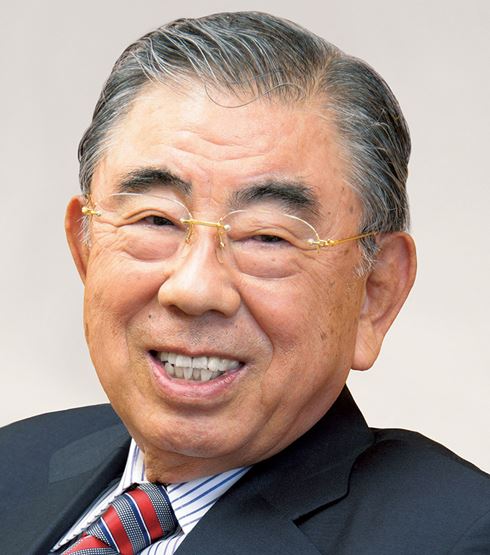
| Bio/Wiki | |
|---|---|
| Profession | Businessman |
| Famous for | Former president of 7-Eleven |
| Physical Stats | |
| Height (approx.) | 5' 8" (173 cm) |
| Weight (approx.) | 65 Kg (143 lbs) |
| Body Measurements (approx.) | - Chest: 40 inches - Waist: 32 inches - Biceps: 10 inches |
| Eye Colour | Black |
| Hair Colour | Salt & pepper |
| Career | |
| Award | Fifth most respected business leader in Japan in January 2004 |
| Personal Life | |
| Date of Birth | 1 December 1932 (Thursday) |
| Birthplace | Nagano, Japan |
| Date of Death | 18 May 2026 |
| Place of Death | Tokyo, Japan |
| Age (at the time of death) | 93 Years |
| Death Cause | Heart failure |
| Zodiac sign | Sagittarius |
| Nationality | Japanese |
| Hometown | Tokyo |
| College/University | Chuo University, Tokyo |
| Educational Qualification | Economics graduate |
| Relationships & More | |
| Marital Status (at the time of death) | Married |
| Family | |
| Children | 2 Son- Yasuhiro Suzuki |
| Parents | Father- Jinshiro Suzuki (Mayor of Sakaki) Mother- Hisaki (Silkworm business owner) |
| Siblings | 9 Note: He was second youngest child. |
| Money Factor | |
| Net Worth (approx.) | $200 million (at the time of death) |
Some Lesser Known Facts About Toshifumi Suzuki
- Toshifumi Suzuki was born in the then-rural Nagano district of Japan, about 125 miles northwest of Tokyo.
- He moved to the capital after finishing high school.
- He was an activist in protests against the university and also for some time a labour union activist, according to his own words.
- Upon graduation, Suzuki went to work for a publishing sales firm. He remained there until 1963 when he met the retailer Masatoshi Ito and a path took him into the world of retailing.
- At the time, Ito was developing one of the first supermarket chains in Japan, called Ito-Yokado, which integrated stores for food and clothing, and others, into a single building.
- Suzuki became part of the company in the same year. In 1971 he was appointed to be a director of “Ito-Yokado”.
- Suzuki had visited America on several occasions in 1973 to complete the licensing agreement for Denny’s restaurant chain, and noticed the convenience store chains, particularly Dallas, Texas’s 7-Eleven.
- He believed that he could find a niche for such stores in Japan, where the people purchased fresh food several times a day, and lived in houses that rarely had much room for storage.
- But most of the executives of Ito-Yokado, as well as those of the economic consultants and industry experts, disagreed.
- They believed that productivity could only be gained by economies of scale, and that only the large store could offer economies of scale. Suzuki said no and succeeded in convincing Ito.
- He then negotiated an agreement with the American parent of 7-Eleven, Southland Corporation, for a licensing agreement.
- Southland reached an agreement with the Southland in November 1973 to license its name and expertise and equipment, and to agree to open 1,200 stores in 8 years, in return for a gross profit royalty of 0.6%.
- Ito-Yokado set up a new subsidiary, Seven-Eleven Japan, with Suzuki as president and Ito as chairman, staffed from outside the retail field.
- The company didn’t attempt to compete on price per unit with supermarkets and has left its accounting system open to the franchisees, to keep trust alive.
- In 1974, Suzuki decided to enter into the Japanese retail business by establishing a Suzuki franchise.
- He introduced the 7-Eleven computerised point-of-sale registers, which were mainly used for stock control in Southland, and expanded the role of the technology.
- These terminals were developed in collaboration with outside contractors such as Microsoft, and hardware partners including NEC, and became one of the most advanced integrated systems of any company in the world.
- This connected tens of thousands of cash registers, hand-held PCs and other devices along the supply chain.
- All staff members were trained on the use of its analytical tools, which analyse customer data, sales data and weather conditions, to inform their daily ordering practices.
- Goods that were newly manufactured and ordered in the morning were delivered to stores before the evening rush.
- Having the correct sales information, the Suzuki company abandoned the normal Japanese custom of sending back unsold products.
- In return he had the entire shelf space and reduced wholesale cost. By 1981, there were more than a thousand stores open and Seven-Eleven Japan was listed on the First Section of the Tokyo Stock Exchange.
- During the same time, there were several other convenience stores that emerged, but none took Suzuki’s dominance, especially in the Tokyo area.
- The company continued to grow in the 1980s with other Ito-Yokado brands such as Mary Ann specialty stores for women opened in 1978 and Robinson’s department stores in 1984.
- In the late 1980s, Seven-Eleven Japan had expanded to the point where it outstripped its parent company in the United States.
- Since Southland was struggling, in 1989, Seven-Eleven Japan acquired the chain’s 58 stores in Hawaii.
- Ito-Yokado bought 70 per cent of Southland in 1991 for a $430-million investment and the introduction of Suzuki’s management systems to the American network.
- Suzuki, president and chief executive, and Ito, chairman, led the rationalisation of 6,700 stores to trim down to 1,200.
- They also oversaw the substitution of its company-owned distribution network with a third-party wholesaler, the enhancement of products, the rationalisation of prices and the installation of an integrated information system based on the Japanese one.
- In 1994 the American version became profitable again.
- The company was later named 7-Eleven Inc. Suzuki remained horizontally managed over the years during an era of expansion, having only a few layers of management between the franchisee and the top management.
- He met once a week with some 160 zone managers at his small rented office in Tokyo, where they exchanged experiences and opinions on even the least of details in marketing.
- There were several thousand other employees & franchisees attending every week at meetings and twice a year at conferences.
- In 1999, the company started its Internet marketing strategy by signing a bookselling deal with Softbank and a books wholesaler, most books being purchased and collected at local Seven-Eleven stores.
- The government’s financial authorities approved Suzuki to open the stand-alone IY Bank in 2001, selling credit cards, loans and ATM machines from the convenience stores.
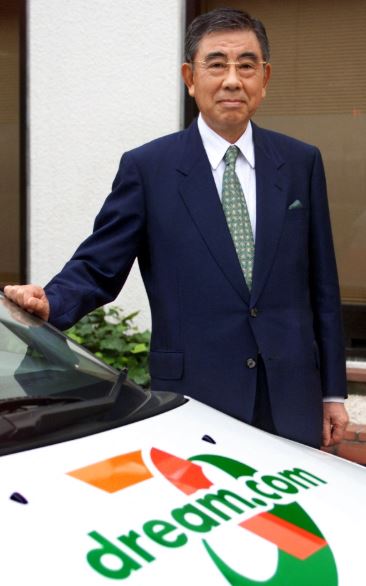
- The next year, he formed a $375 million collaboration with NEC, Nomura Research and Sony called 7-dream.com, which sold through 100,000 products and services via the Internet, while local stores offered pick-up points.
- The Seven-Eleven Japan chain sold over 10,000 units by 2003 and by that year the 7-Eleven network worldwide sold over 28 billion dollars worth of goods.
- In January 2004, Suzuki was voted the fifth most respected business leader in Japan in the Nikkei Industrial News poll.
- In 2000, he published two books, The Essence of Management, Spontaneous Managerial Decisions Based on Conviction, in Japanese, and in 2003 The Starting Point of Business.
- He also did some work at this time to increase Ito-Yokado’s presence in China, and was vice chairman of the Keidanren business organisation, serving on government commissions related to the environment, business ethics and long-term economic strategy.
- Prior to his promotion to president and chief executive officer of 7-Eleven Inc., Suzuki was acting chairperson of the company.
- He assumed the leadership of the top position on 5 November 2005 after James W. Keyes resigned, but a search for a new permanent leader was underway.
- He stepped down at the end of April 2016 after a management reshuffle failed.
- Suzuki passed away on 18 May 2026 due to heart failure. Seven and I Holdings announced this news on 25 May 2026. He was 93 years at the time of his death.
 Jagadish Kumar (Bigg Boss Kannada) Family, Biography
 Alexandra Djavi Height, Age, Death, Boyfriend, Family, Biography & More
 Shaji Choudhary Height, Age, Wife, Children, Family, Biography & More
 “Badhaai Ho” Actors, Cast & Crew: Roles, Salary
 Sruthi Lakshmi (Bigg Boss Malayalam 5) Height, Age, Husband, Family, Biography & More
 Blind Actors, Cast & Crew
 Samir Modi Height, Age, Wife, Children, Family, Biography
 Buneet Kapoor Height, Weight, Age, Girlfriend, Family, Biography & More