
Erfan Soltani Age, Biography
Quick Info→
Hometown: Tehran, Iran
Age: 26 Years
Marital Status: Married

| Bio/Wiki | |
|---|---|
| Profession | Shopkeeper |
| Known for | Being the first man to be executed during the anti-Khamenei protests in Iran in 2026 |
| Physical Stats | |
| Eye Colour | Brown |
| Hair Colour | Light Brown |
| Personal Life | |
| Date of Birth | Year, 1999 |
| Age (as of 2025) | 26 Years |
| Birthplace | Fardis, Karaj, Iran |
| Nationality | Iranian |
| Hometown | Tehran, Iran |
| Religion | Islam |
| Food Habit | Non-vegetarian |
| Relationships & More | |
| Marital Status | Married |
| Family | |
| Children | He has children. |

Some Lesser Known Facts About Erfan Soltani
- Soltani runs a cloth shop in Fardis, Central Iran.
- On 8 January 2026, he was arrested near his home during anti-Khamenei protests in Fardis, west of Tehran, Iran.
- After many days of his arrest and disappearance, it was announced that Soltani could be executed on 14 January 2026. He had received a death sentence with no charges, trial, or lawyer.
- The security agents informed his family of the sentence and allowed only one short meeting with him before his execution.
-
The officials warned the family not to talk publicly, or they would face arrest.
- He made headlines for being the first person executed in Iran’s crackdown on protesters, who demanded regime change during the economic crisis and corruption.
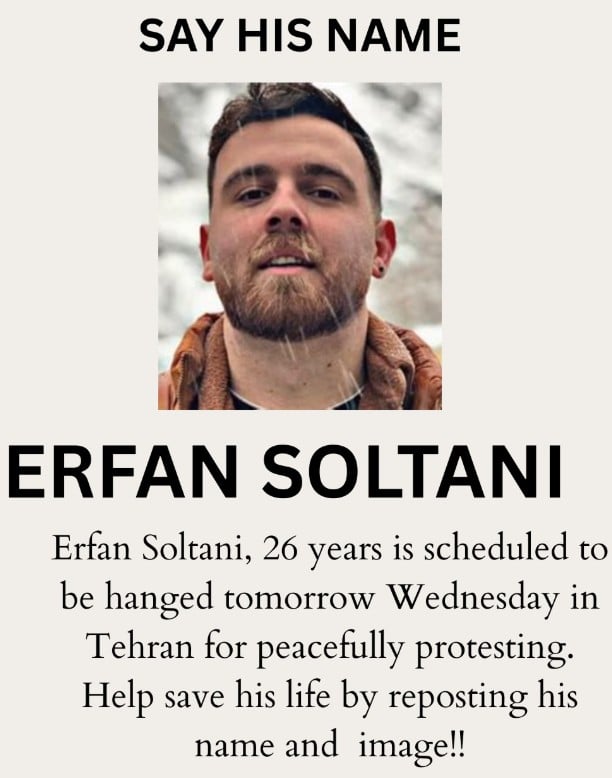
Erfan Soltani on the poster of his execution
-
His sister, a lawyer, tried to handle her brother’s case through legal procedures, but she was not permitted to access the case files.
- His family told a human rights group that Erfan was not involved in politics; he was simply a protester among the young. They said,
He was never a political activist, just part of the younger generation who was protesting against the current situation in Iran.”
- A human rights group told the media that Erfan could not hire a lawyer for his defence. They stated,
Since his arrest, Erfan Soltani has been deprived of his most basic rights, including access to legal counsel, the right to defence and other fundamental due-process guarantees.”
- On 15 January 2026, his execution was cancelled by the Iranian government.
 Masoud Khamenei Age, Caste, Family, Biography
 Reza Pahlavi (Crown Prince of Iran) Age, Girlfriend, Wife, Children, Family, Biography
 Ebrahim Raisi Age, Death, Wife, Biography
 Hassan Rouhani Age, Wife, Children, Family, Biography & More
 Golshifteh Farahani Height, Age, Boyfriend, Husband, Family, Biography & More
 Donald Trump Height, Age, Wife, Children, Family, Biography
 Donald Trump Jr. Height, Age, Girlfriend, Wife, Family, Biography
 Nadia Murad Age, Story, Boyfriend, Husband, Family, Biography & More